Riyadh Airport Hit Again as Houthis Warn Airlines
A second attack in two days struck King Khalid International Airport in Riyadh, causing a terminal fire and injuries, while Yemen's Houthis claimed responsibility and warned airlines to avoid Saudi airspace.

By Sylvester Eyamah
Oct 12, 2026, 7:18 PM · 3 min read
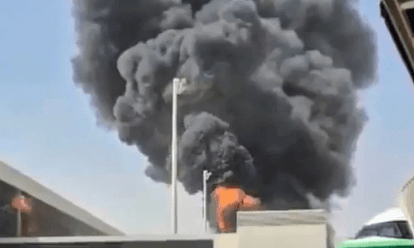
King Khalid International Airport in Riyadh has endured a second major assault in as many days, with officials reporting a fire inside a passenger terminal and several people hurt. A Saudi military representative said late Sunday, October 11, that a projectile had hit the airport, and the national civil aviation authority confirmed that people had been injured.
The strike came one day after a devastating attack on Saturday that left 12 dead and more than 300 wounded. The airport had also been targeted in separate incidents earlier in the week.
Yemen's Houthi movement said it was behind the fresh wave of attacks and cautioned commercial carriers and travelers to stay away from Saudi airports and the kingdom's airspace. The group said it had fired ballistic and cruise missiles as well as drones at the airport during a 24-hour span. Houthi military spokesman Brigadier General Yahya Saree also claimed that oil facilities and Dammam Airport in eastern Saudi Arabia had been hit.
Saree pledged to continue what he called "escalating operations deep inside Saudi Arabia," and warned that aviation hubs throughout the country were still at risk, except for those in the holy cities of Mecca and Medina.
The Houthis have linked the military campaign to Saudi Arabia's support for government forces in Yemen's civil war and to alleged coalition air strikes on Sanaa International Airport.
Major General Turki al-Maliki, a spokesman for the Saudi-led coalition, said air defenses intercepted a missile near Riyadh's airport. At the same time, he said, crews were sent to put out a fire caused by an "unknown projectile" that struck Passenger Hall No. 4.
Foreign leaders reacted quickly as violence mounted. U.S. President Donald Trump said Washington would "make a decision" about a possible military response to the Houthis and would "move very quickly." British Defence Secretary Wes Streeting said the UK could "potentially" provide further defensive support to Saudi Arabia.
Saturday's attack was among the deadliest single strikes on Gulf infrastructure since regional hostilities intensified. The Saudi-led coalition called it a "war crime" and promised a strong response.
The Saudi General Authority of Civil Aviation said those killed in Saturday's strike included four Saudis, two Bangladeshis, and one citizen each from the United States, Jordan, Palestine, Syria, Sudan, and Egypt. The Indian Embassy in Saudi Arabia also said an Indian national had died from wounds suffered in the attack.
U.S. Secretary of State Marco Rubio condemned the strikes and confirmed that an American citizen was killed. British Foreign Secretary Ed Miliband voiced deep outrage. The UK Foreign Office then revised its travel advice, recommending against all travel within 10 kilometers of the Yemeni border.
Houthi-run Al Masirah television reported that coalition forces launched a retaliatory air strike on Sanaa International Airport. Saudi officials have not formally confirmed the claim, and independent verification has not been completed.
Abdullah Al-Alimi Bawazir, vice-president of Yemen's internationally recognized government, called on regional and international partners to take "decisive actions" to stop the escalating violence. The renewed fighting comes after a temporary ceasefire brokered in 2022 collapsed in July, adding to regional tensions following recent territorial changes along Yemen's Red Sea coast.
Newsletter
Get the biggest stories in your inbox
A concise morning briefing, curated by Chronicle editors.